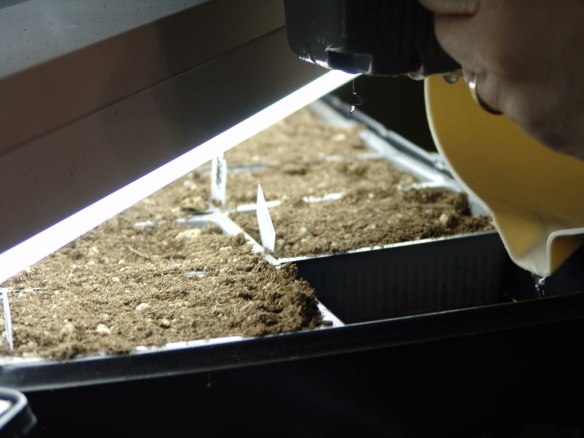
After an initial watering from the top, we bottom water so as not to encourage damping off. They will wick it up from the bottom getting right to where it needs to go – the roots.


After an initial watering from the top, we bottom water so as not to encourage damping off. They will wick it up from the bottom getting right to where it needs to go – the roots.
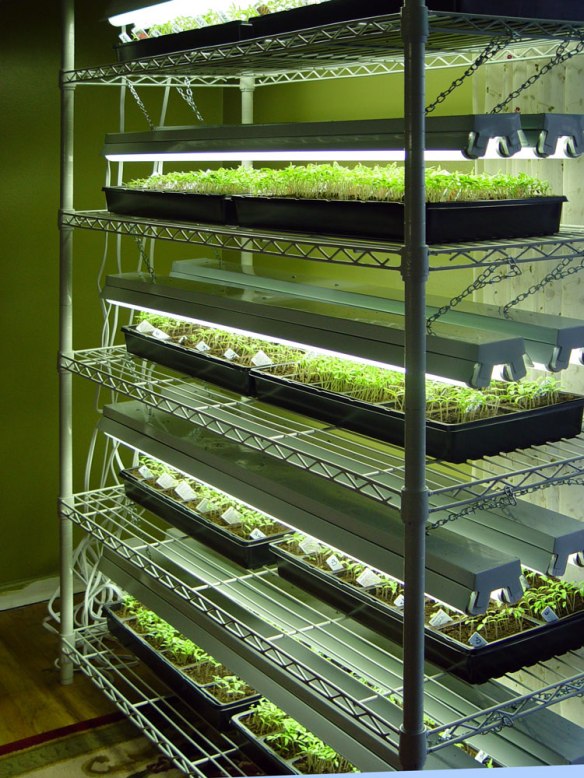
This is a shelving rack with ordinary fluorescent lights hovering just above flats full of tomato plants. The lights need to be close to provide light and warmth otherwise the plants will get leggy

When growing for your home garden, start seeds 8 weeks prior to the last frost date. Always use sterile seed starting mix and sterile pots. Buy them new every year or sterilize used pots with a 10% bleach solution. Sometimes I run mine through the dishwasher on the top rack and toss a little bleach in before I start the wash cycle (damping off can be a real problem if you don’t.)
Place the seeds on top of the medium; cover with about 1/4” inch of mix and press down with your hands to smooth. Sprinkle with water from a “gentle” watering can to avoid washing the seeds away. I then fill my flats with hot water until they start floating, they will absorb this.
Put them in a warm place. Mine go under ordinary fluorescent lights, about an inch away from the flats, in the dining room. The heat from the lights keep it warm. (You can use bottom heat such as a heating mat or the top of refrigerator if you like.) Bottom water as needed, don’t let them dry out. In about a week you should start to see germination. Grow them under the lights until you see the first true leaves, a pair of true leaves. Transplant into larger pots.
Peppers seem to take forever to germinate, sometimes as much as 3 weeks. Tomatoes can be up as early as 4 days from planting.
Key points for maximum success:
sterile seed starting mix
sterile pots
warm location for germination
water from the bottom
good ventilation
These basic instructions work for just about every seed you want to start in pots to get a jump on the season. I will post more on starting different kinds of seeds and their needs in other posts so stay tuned.

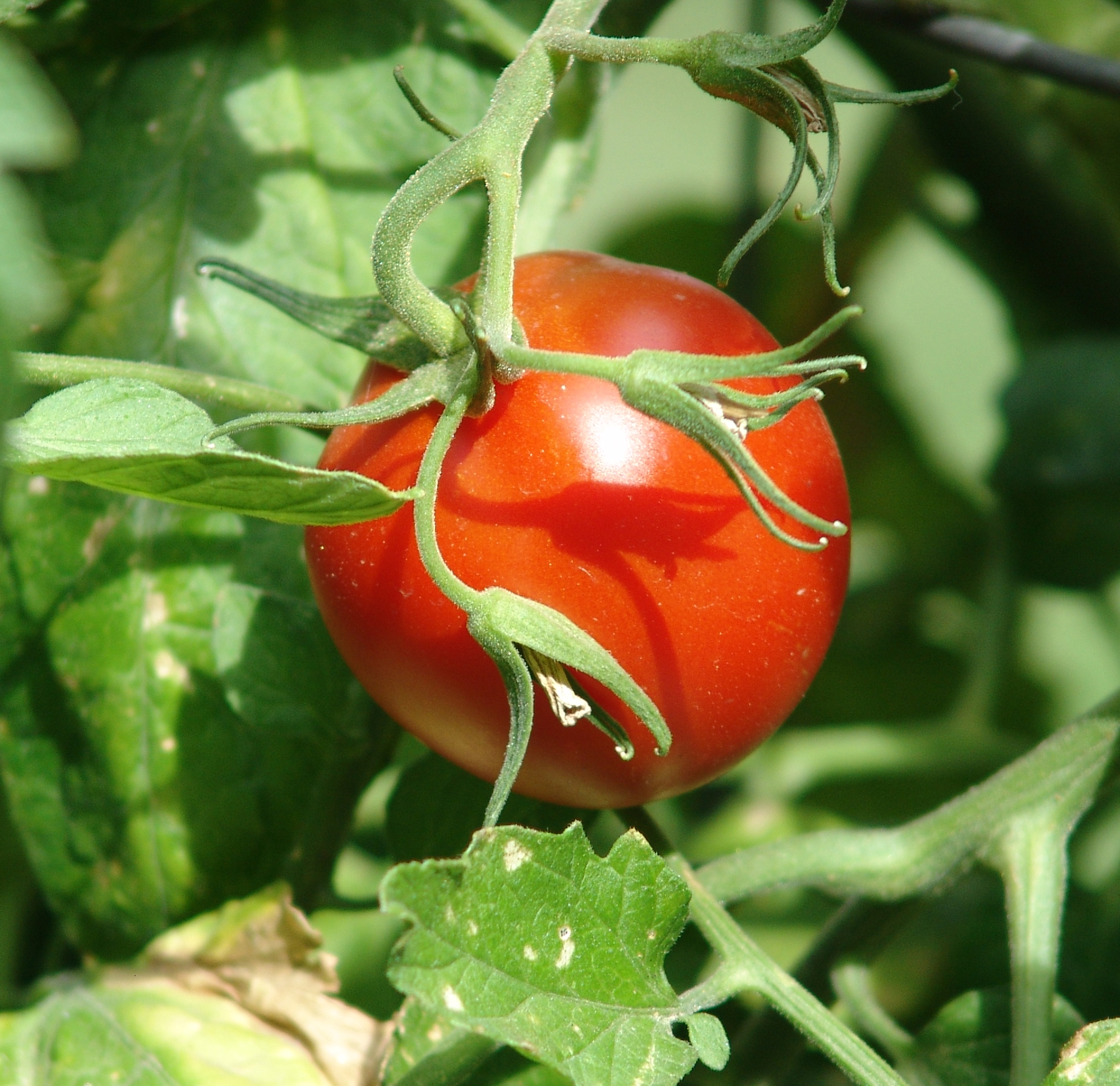
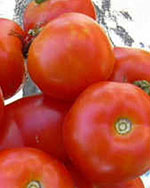
Here I captured them on the vine. They produce in trusses of fruit.
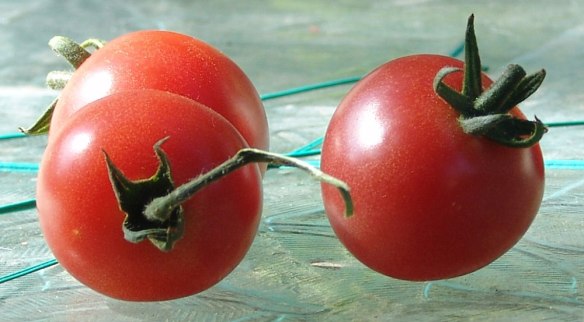
Sweet Treats was a new one for me last year. I love, love, love this cherry tomato and will grow this variety again. It was one of the first to ripen, had loads of dark pink, ping pong sized cherry tomatoes that were deliciously sweet. I had so many that I actually canned several quarts of them for fun and made some sauce. Because I didn’t want slip the skins off of them, I cooked them and then ran them through a sieve to strain them. They made an incredibly sweet and mouth watering sauce. The plant is very big, for us it was over 6 feet tall and very bushy. Definitely needs staking.
So, yesterday, March 25, I planted around 4000 tomato seeds with the help of two friends, Heidi Eutsler, Kathy Kjelgaard and my lovely husband, Steve. It’s not back breaking (unless you count hunched over for hours) but when you are doing 168 plus varieties, it’s a lot of work. I use a sterile seed germinating mix and sterile containers. This cuts down on the problem of damping off. On Friday, Saturday and Sunday, I transplanted 2000 babies (tomato plants). Now that’s back breaking! Friday night it got really cold and the two heaters we had in the greenhouse didn’t cut the mustard and when I checked on them the next morning, they looked like canned spinach. Not a good thing. I lost 300 plants. The next night, we put in 4 heaters, (space heaters) and ti worked like a charm. Good thing since I had spent the day transplanting. Today, I am going to transplant pepper plants.
In our neck of the woods (Inland Northwest – Spokane and surrounding areas) summer seems to come later and later. Lately, June seems to be more rainy than usual. Last year, I started telling everyone that tomatoes were a fall crop!
I entered several in the fair and by the time it rolled around in the beginning of September, I still didn’t have any large tomatoes to share. I had plenty of cherry tomatoes and some smaller varieties but no prize winners… until two weeks after the fair. Sigh. After that, I had billions of tomatoes to eat and share and can (I put up 75 quarts).
One of the ways we cope with our shorter climate (and I have absolute sympathy for Deer Park gardeners) is to plant “early” tomatoes. One thing I have found is that they aren’t substantially earlier than mid-season tomatoes. As for late season, I always get beautiful crops of those also, probably due to our actual frost date being sometime in later October. Here is some info on early tomatoes.
Early season tomatoes ripen fruit in 55 to 70 days after being transplanted to the garden as 6-8 week old plants.
Because great tomato flavor comes with just the right combination of sugars and acids that are the product of sunlight and photosynthesis, early season tomatoes are often dismissed as less tasty than mid- and late-season tomatoes (which require 80 to more than 100 days to ripen) because they spend fewer days in the sun.
Many “early” tomatoes—which are often smaller and less leafy than later season tomatoes–can flower and set fruit in cool, early-season conditions. Given optimal conditions, early-season tomatoes can produce fruit equally flavorful to the best late-season varieties. I like the pink “Early Wonder”, “Stupice”, “Anna Russian”, and “Subarctic Plenty”. Those are very tasty.
Cherry tomatoes are also earlier than the larger varieties but that is another post.
Anna Russian (open-pollinated). Slicing tomato. Pink-red, heart-shaped, 10 oz. fruits; juicy, excellent sweet flavor. 70 days. Indeterminate.
Early Wonder (open-pollinated). Slicing tomato. Dark-pink skinned to 6 oz.; full flavored. 55 days. Determinate.
Stupice (open-pollinated). Slicing tomato. Red-skinned, small to medium-sized to 4 oz.; sweet, juicy. 50 days. Dwarf determinate, compact. For short-season regions. From Czechoslovakia.
Sub Arctic Plenty (open-pollinated). Slicing tomato. Small, round to 2 oz.; good flavor. 50 days. Determinate. Compact. Sets fruit in cold weather. Those were the last to succumb to the weather and I loved the taste.
In order: Anna Russian, Early Wonder, Subarctic, and Stupice.



Boy, it’s taken a very long time for them to start germinating.Yesterday, the serranos started poking there heads above” ground”. One of the new varieties that I am growing is called “Fruit Basket” It is supposed to be for hanging pots. They are 68 days. Its low, spreading form reaches just 10 to 12 inches tall but spreads up to 2 feet. According to the literature, it is supposed to be a sweet bell with a peppery bite and sometimes will grow as large as 5″ long. I can’t wait to try it!
Sunday, the first of babies started showing up. I’ts amazing, we check several times a day hoping to see a shoot and nothing. The next morning you look and lo and behold they are there! The odd thing is that the peppers have only shown one volunteer, a giant marconi. It is the only one and they were planted at the same time as the tomatoes on the third of March, I think it was. As for outside, there are some yellow anenomes that are cheerfully blooming in the garden. After a tour of the garden beds I see a whole row of garlic that we missed and an onion that are about 3 inches high. No asparagus yet although I do see the tips of the rhubarb.
In the greenhouse, I have cabbage “Copenhagen” that I transplanted into cell packs. I’m thinking that I can put them outside since they can take quite a bit of cold. The hollyhocks and geraniums have been transplanted in cell packs and the alyssum and lobelia will be next. One of our cats got into the greenhouse and there are big footprints in some of the single cell starter packs. I am not happy.
Still it is wonderful to go into my little greenhouse and and see the blooms of the geraniums that I carried over last winter. One of my miniature roses is even starting to bloom!
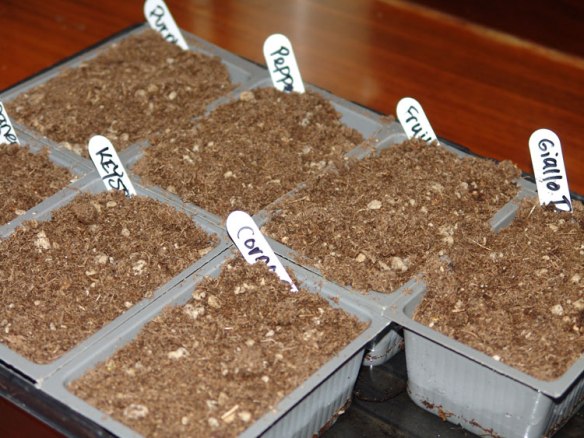
…but they will be someday. On Sunday, March 3rd I and a friend planted about 1500 pepper seeds. This is what they look like pre germinating. this year. This year I will have 41 varieties, including red, yellow and caribbean red habaneros, purple and red cayenne, anaheims, poblanos and sweet purple bells. Did you know that poblanos and anchos are the same thing? When they are dried, they become anchos.
garden and art
sharing my experiments in crafting
Big plans for a small garden
EXPLORING COVETED LITTLE LUXURIES
Experiences in Backyard Biological Gardening
My weekend baking trials, tribulations and some triumphs
Remarkable Beaded Jewelry, Hair Accessories, & More
random thoughts from an eclectic mind
The latest news on WordPress.com and the WordPress community.
 Notes From The Tomato Lady