These are more pictures of the Indigo Rose in our garden

 This is a picture from one of our customers. He grew it in a pot and it is enormous! They look like giant blueberries.


These are more pictures of the Indigo Rose in our garden
This is a picture from one of our customers. He grew it in a pot and it is enormous! They look like giant blueberries.
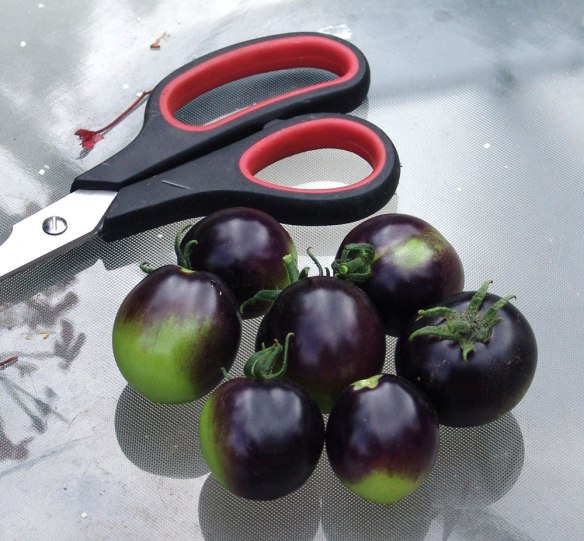
this is a picture of the Indigo Rose grown in our garden this year. It is stunning in color, not so much in flavor in my opinion. These are dark purple on the parts that get by the sun and green on the other side. We picked one and when it got really ripe, it was orange on purple. Really pretty but I thought it was tart.
Spiced Tomato Jam
1 1/4 pounds ripe tomatoes
1/4 cup lemon juice
1/2 tsp cinnamon
1/4 tsp allspice
1/4 tsp cloves
1 pckge powdered pecton or Sure Jell
4 1/2 c sugar
Wash firm ripe tomatoes. Scald, peel and chop. Puree in blender. Measure 3 cups of pureed tomatoes into a large saucepan. Add lemon juice, the ground spices and pectin.
Over high heat, bring mixture to a rolling boil, stirring constantly. Add sugar all at once, keep stirring and bring back to a rolling boil (a boil that can’t be stirred down). Boil for 1 minute.
Remove from heat and let cool for 5 minutes. Skim off foam with a metal spoon. Pour jam into jars, leaving 1/4 inch head room. Wipe the lip clean and tighten lids. Process how you would like to. Water bath would work well.
Makes about 5 half pint jars.
The recipe comes from Tzena Scarborough in Spokane Valley WA. She writes,” This is a Scarborough family favorite when tomatoes were in abundance in their garden. Mom found this recipe in the Sure Jell package.”
Making and Canning Pasta Sauce
This is a nice basic recipe for making pasta sauce. Soon, we will have a glut of tomatoes on our hands and will need ways to preserve them.
Here in the Inland Northwest, we have gone from 50 something degrees to 99 degrees in a matter of days it seems. Not only does that play havoc with our human bodies but it can have consequences in our gardens.
The common miconception is that tomatoes love heat, the hotter the better. Not so much. High temperatures can cause several problems with tomato production. One of them is “tomato blossom drop.” The tomato blossoms “dry up and fall off the plant before a fruit is formed.”
“Tomatoes grow best if daytime temperatures range between 70 F and 85 F. Tomato plants can tolerate more extreme temperatures for short periods, but after several days or nights with temps outside the ideal range, the plants start to focus on survival not producing fruit. High nighttime temps are even worse than high daytime temperatures because the tomato plant never gets to rest.”
Another tomato response to extreme heat involves its leaves. Just as they respond to very cold temps and lots of moisture with their leaves, you will notice that some tomato varieties also respond to heat by curling their leaves. That’s a defensive mechanism that attempts to slow transpiration (evaporation from the leaf surface) of water from plant to atmosphere.
Specific temperatures at which blossom drop begins will vary from variety to variety. If you experience this, all is not lost, they will eventually snap out it. Water thoroughly early in the morning or put a drip system on at night to keep them well hydrated. Mulch to help retain their moisture. And pray for more temperate weather!
We have been having huge shifts in temperature lately. From 80’s to the 50’s and lots and lots of rain. Our tomatoes are reacting to these changes on an individual basis. some of my varieties, actually most of them, are doing well. A couple have leaf spots (I’ll do a separate post of that at a later date), my “Cougar Red” has some curled, rolled leaves (other than that it is healthy). I have done some research on the latter and this is what I’ve found:
“Leaf Roll:
During very wet seasons, tomato plants frequently show an upward rolling of the leaflets of the older leaves. At first this rolling gives the leaflet a cupped appearance. Later, the margins of the leaflets touch or overlap. The rolled leaves are firm and leathery to the touch. One half to three-fourths of the foliage may be affected. Plant growth is not noticeably checked, and a normal crop of fruit is produced. Frequently leaf roll occurs when tomato plants are pruned severely, and it is very common when unusually heavy rains cause the soil to remain moist for long periods of time.
To prevent leaf roll, keep tomato plants on well-drained, well-aerated soil, and protect them from prolonged periods of heavy rainfall if you can.”
Also this: (Univ. of Colo.)
“Leaf roll, or leaf curl, is a physiologic distortion that may develop with periods of cool, rainy weather. It cause the lower leaves to roll upward and become thick and leathery. Leaf roll does not affect plant growth or fruit production and requires no treatment.
Leaf Roll
Herbicides can distort the foliage and fruit of tomatoes. They are especially sensitive to 2,4-D. Damage can bend the leaves down, causing cupping and thickening. New leaves are narrow and twisted and do not fully expand. Fruit may be catfaced and fail to ripen. Exposure can occur when herbicides are applied to lawns for weed control and the spray “drifts”. Resultant fumes can also effect the plants for several days after treatment. Clippings from grass that has been sprayed with a herbicide should not be used as mulch in the vegetable garden. If the exposure is minimal, the plant will outgrow the injury. Be sure to water the affected plants thoroughly and often.”
I guess I will have to wait and see how they turn out. In the meantime, the “Cougar Red” is in it’s own pot and segregated to be on the safe side.
Flea Beetles, A common problem this time of year. It has come to my attention that they are afoot. If your leaves have what looks like little shot holes you might/probably have flea beetles. They seem to attack the lower leaves first. Here is a link ot a site that gives you good information as to what they looks like, how they overwinter and what to do about it.
http://www.ext.colostate.edu/pubs/insect/05592.html
 flea beetle damage
Sunday, May 26
10:30 am
We have been driving for about an hour and a half and not a coffee shop in sight unless you count McDonald’s and Hardee’s. We’ve been through about 7 towns now. There is bubba’s shrimp shack, boiled peanuts, and flip flops with bottle openers built into the shoe at the local convenience stores, but not a decent cup of coffee. With the exception of Starbucks and Dunkin’ Donuts they don’t have coffee here. In Spokane we would have passed 148 places by now. Maybe it’s too hot. I would almost give my right arm for a Dunkin’ Donuts.
The flora and fauna has changed in the last couple of hours, less palms, more pine trees. The weeds and grass seem finer too. Further south, the grass is St Augustine’s which is hte only stuff that can take the heat, the sand and the bugs. It is very coarse and to my Inland NW way of thinking, it isn’t all that attractive.
This picture is what the highway looks like, for miles and miles. Occasionally you see an old little house slowly being assimilated back into the landscape.
There are a lot of churches here. Baptist, Catholic, Church of the Woods, Larry’s Church, Joe’s Church, Harriet Woods Ministries, you get my drift. There may be 10 0r 15 of them in a row. Deb reminded me that this is the Bible Belt.
I’ve seen fields of head high corn, golden wheat ready to be cut and roadside stands of Georgia peaches. I think it’s peach season now. When we get to Georgia I will let you know.
Haven’t seen any rednecks yet, unless you count those with sunburns at the beach. I’m not trying to stereotype but lets face it we all have our prejudices. I think, that we think, that everyone in the south is a redneck and everyone here thinks, we all live in Seattle in the rain. Actually, you don’t hear any southern accents, most people in southern Florida are transplanted from the east coast, like New York.
There are a lot of highway patrol here. At night, it looks like a holiday light parade with all the lights flashing on the side of the road! It’s probably because these straight, well maintained roads beg to be driven on like a racetrack. And they do. Thank goodness for cruise!
10 pm
We are finally here! It is a little B&B in Crawford, Georgia called the Chicken Coop. The proprietors are a sweet couple who waited up for us. Pictures to follow tomorrow, too tired tonight.
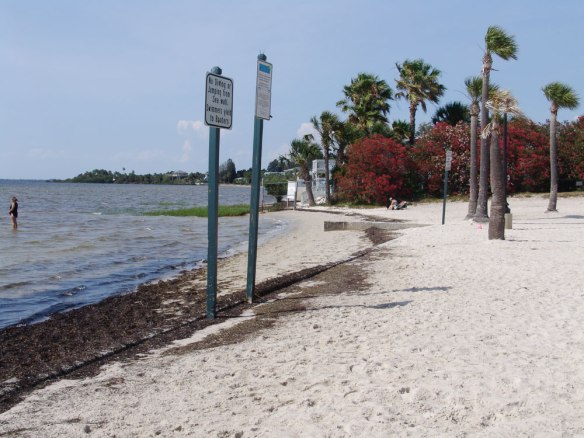
Another look, the other way at the beach, note the oleander bushes in the background. Very breezy and humid but nice.

Photo one of the beach I sat on today. I believe it is called Pine Island beach.
garden and art
sharing my experiments in crafting
Big plans for a small garden
Experiences in Backyard Biological Gardening
My weekend baking trials, tribulations and some triumphs
Remarkable Beaded Jewelry, Hair Accessories, & More
random thoughts from an eclectic mind
News, Tips & Website Tutorials

 Notes From The Tomato Lady