What To Do When Dahlia Tubers Sprout Early?

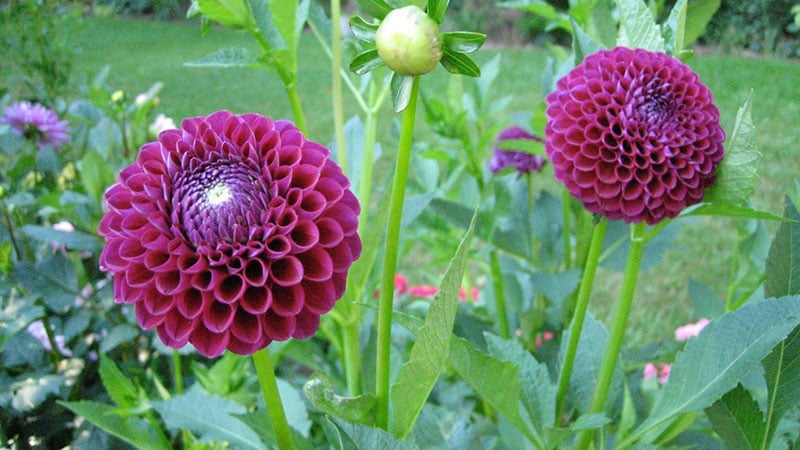
Those of us who save our dahlias have probably encountered this problem. I know I have. Here is the answer to that question courtesy of Garden Making. I believe they are out of Canada so they use celsius temperature which is easily convertable.

What to do when stored dahlia tubers sprout early? By Garden Making

Question: Michael in Niagara-on-the-Lake, Ontario, asks:
Dahlia tubers that were stored in peat moss in the basement have started to send up shoots. They’re  in the coldest part of the basement, but it is 14 to 16°C in the room with about 35% humidity. Should the sprouts be trimmed off? Left alone?

Answer: Nick Vanderheide of Creekside Growers in Delhi, Ontario, says:
The issue at hand is really the storage conditions. Dahlias will sprout under warm, damp conditions, and anything above 10° C is considered warm. The humidity level of the room may very well be 35%, but do you know what the humidity is in the peat moss? You want to maintain a decent amount of moisture in the tubers (not the media it’s stored in) so at 35% room humidity, it is a good thing to put them in peat moss to prevent them from drying out.Heat is the big deciding factor in sprouting. Spring soil temperature is usually around 12 to 16°C when we plant and that causes the tubers to sprout, so if they are in a room at that temperature they will definitely start growing.

In the Netherlands, this sprouting is actually how new, true-to-type, dahlias are produced. The tubers are forced indoors to produce little shoots which are then cut off, rooted and grown as plugs to then plant in the field for the summer where they will produce a new tuber that can be harvested in the fall.The shoots on your tubers can be trimmed or not; they will not affect the viability of the tuber come spring time.

One thing to consider, though, is that the tuber is simply a storage organ for the energy it needs to grow come spring time, so if your tubers continue to try to grow, they are using up energy that they need in the spring to become a big, healthy plant.I would strongly suggest getting those dahlias into a colder area to slow down that sprouting. And then stop worrying—spring is only a few short months away!

Source: What to do when dahlia tubers sprout early?

Wise Pairings: Best Flowers to Plant with Vegetables – Organic Gardening – MOTHER EARTH NEWS

adelaide festival 7 6 17This is a long article but I thought it is worth sharing.

Wise Pairings: Best Flowers to Plant with VegetablesPlant a profusion of pollen- and nectar-rich flowers among your edible plants to naturally control pests, boost pollination and provide pretty pops of color. Here, learn some of the best flowers to plant with vegetables and get tips for arranging your space.By Rosalind Creasy | February/March 2015     As you plant flowers in the vegetable garden, play with colors and textures as the author does in her beautiful central California edible landscape.Photo by Rosalind Creasy In the 1970s, when I was a budding landscape designer newly exciting about strategizing the best flowers to plant with vegetables, I attended the garden opening of one of my clients. As I walked around anonymously, wine glass in hand, I overheard many guests exclaiming, “Do you see that? She put flowers in the vegetable garden!”In the United States, segregating vegetables from flowers still seems like such a hard-and-fast rule that when I lecture on edible landscaping, one of the first things I mention is that I’ve checked the Constitution, and planting flowers in a vegetable garden is not forbidden. Not only can you put flowers in with vegetables, you should.I admit that, in the ’70s, I first intermixed my flowers and vegetables because I was gardening in the front yard of my suburban home and hoped the neighbors wouldn’t notice or complain as long as the veggies were surrounded by flowers. Soon, however, I discovered I had fewer pest problems, I saw more and more birds, and my crops were thriving.It turns out that flowers are an essential ingredient in establishing a healthy garden because they attract beneficial insects and birds, which control pests and pollinate crops. Most gardeners understand this on some level. They may even know that pollen and nectar are food for insects, and that seed heads provide food for birds. What some may not realize is just how many of our wild meadows and native plants have disappeared under acres of lawn, inedible shrubs and industrial agriculture’s fields of monocultures, leaving fewer food sources for beneficial critters. With bees and other pollinators under a chemical siege these days and their populations in drastic decline, offering chemical-free food sources and safe havens is crucial. Plus, giving beneficial insects supplemental food sources of pollen and nectar throughout the season means they’ll stick around for when pests show up.-Advertisement- Envision an Integrated Edible LandscapeOne of the cornerstones of edible landscaping is that gardens should be beautiful as well as bountiful. Mixing flowers and vegetables so that both are an integral part of the garden’s design is another key. Let’s say you have a shady backyard, so you decide to put a vegetable garden in the sunny front yard. Many folks would install a rectangular bed or wooden boxes, and plant long rows of vegetables, maybe placing a few marigolds in the corners, or planting a separate flower border. In either case, the gardener will have added plants offering a bit of much-needed pollen and nectar.Integrating an abundance of flowers among the vegetables, however, would impart visual grace while also helping beneficial insects accomplish more. Plentiful food sources will allow the insects to healthily reproduce. Plus, most of their larvae have limited mobility. For example, if a female lady beetle or green lacewing lays her eggs next to the aphids on your violas, the slow-moving, carnivorous larvae won’t be able to easily crawl all the way across the yard to also help manage the aphids chowing down on your broccoli.In addition to bringing in more “good guys” to munch pests, flowers will give you more control because they can act as a useful barrier — a physical barrier as opposed to the chemical barriers created in non-organic systems. The hornworms on your tomato plant, for instance, won’t readily migrate to a neighboring tomato plant if there’s a tall, “stinky” marigold blocking the way.Create Cool Combos of Flowers and VegetablesTo begin establishing your edible landscape, you should plant flowers with a variety of colors and textures, different sizes and shapes, and an overall appealing aesthetic. After you’ve shed the notion that flowers and vegetables must be separated, a surprising number of crop-and-flower combinations will naturally emerge, especially if you keep in mind the following six guidelines.1. Stagger sizes. Pay attention to the eventual height and width of each flower and food plant (check seed packets and nursery tags), and place them accordingly. Tall plants, for the most part, belong in back. They’ll still be visible, but they won’t block the smaller plants from view or from sunshine. A good rule is to put the taller plants on the north and east sides of your garden, and the shorter ones on the south and west sides.-Advertisement-2. Consider proportions. A 6-foot-tall sunflower planted next to an 18-inch-tall cabbage would look lopsided. Instead, place

Source: Wise Pairings: Best Flowers to Plant with Vegetables – Organic Gardening – MOTHER EARTH NEWS

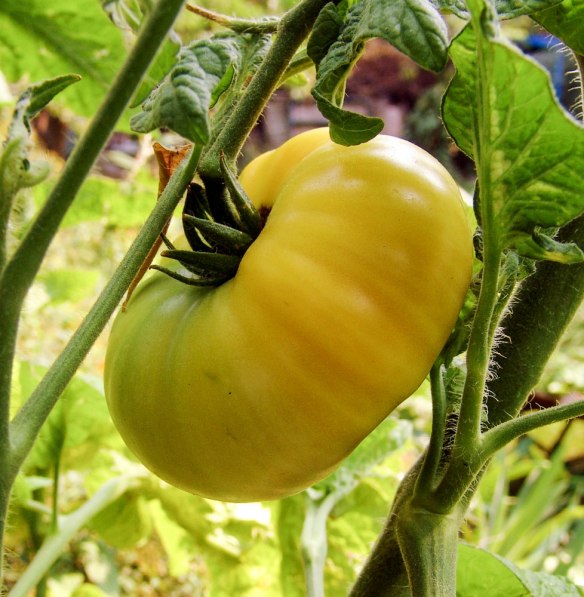
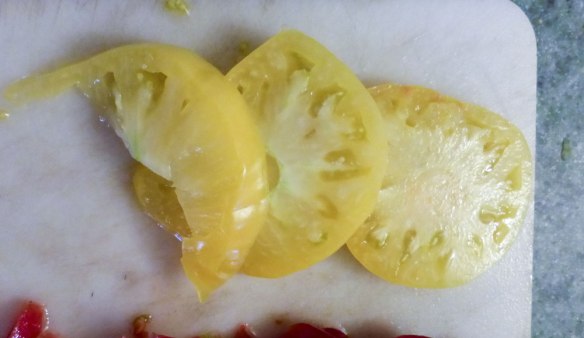
Meet Mr. Snow, a Lovely, Light Yellow Tomato With a Sweet, Delicate Taste

mr-snow-2-81017

This is Mr. Snow in the wild.

Mr-Snow-cut-81217

This is Mr. Snow on a cutting board about to be devoured.

One of the Dwarf Tomato Project varieties that I tried this year. It is astoundingly sweet. They are medium size, measuring about 3 inches across, as with most heirlooms, the size can vary widely.

It sits in a very large pot near my arbor and is doing well in spite of the heat. And the shade. However, it isn’t getting as much light as it would like and is producing, albeit not heavily. It takes a lot of energy to produce fruit. As my trees grow in my yard I am realizing that what was once full sun is no longer. I’d like to see how it performs in the ground out in the garden where it will get full sun.

I was surprised at how juicy and sweet this one tastes. The color is charming, a very light yellow. It would look pretty in a salsa or in a mixed color tomato salad plate as shown here. Well, it’s really a cutting board, with cucumbers from my garden (Beth Alpha) but you get the gist.

mr-snow,-fred's-tye-dye-and---81217

The other two tomatoes are Fred’s Tye Dye and Tye Dye which I will showcase in a future post.


Largest Tomato I’ve Ever Laid Eyes On! Kellogg’s Breakfast

No kidding, would you look a the size of that tomato! Compared to the dog anyways.

Kellogg Breakfast & Scout

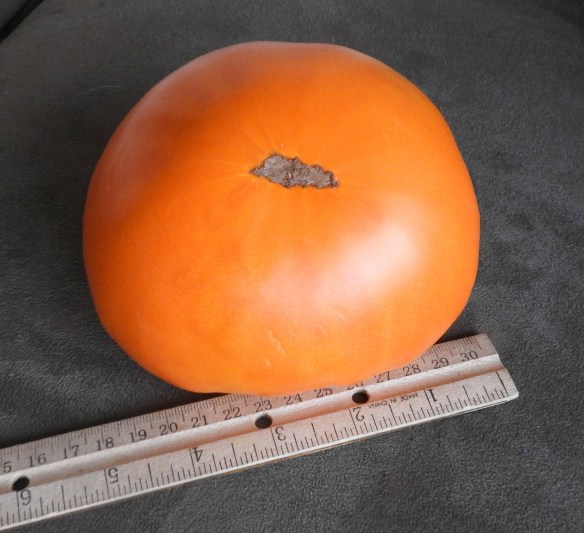
This is a photo sent to me by one of my customers. Janet Y. It is a Kellogg’s Breakfast, one of our customer favorites. the second picture shows the scale with a ruler. Almost 5 inches! Wow! I see BLT’s in her future. Plus it is only the first part of August. Ours are just now starting to color up.

Kellogg Breakfast

The story goes like this: Ironically enough. this tomato is not named for the breakfast cereal developer of fame, Will Keith Kellogg, but for a humble gardener, Darrell Kellogg, a railroad supervisor in Redford, Michigan. He received his seed from a friend in West Virginia where it originated.

Sweet and meaty, he liked the tomato so much he saved the seed and began to breed the variety. A brilliant orange and nearly blemish free, they can grow to weigh a pound or more.

Kellogg’s breakfast tomato was voted one of the best tomatoes by Sunset magazine.

Pink Passion Dwarf Tomato and Why Tomato Shoulders Stay Green or Yellow

pink-passion-73017---6

Pink Passion

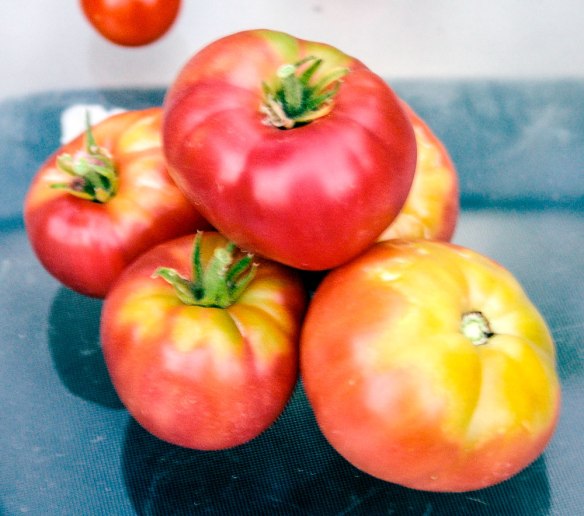
This is the first picking of tomatoes from one of my Dwarf Tomato Project plants. It is called Pink Passion. A bit blurry, I apologize. Some are slightly heart shaped, pinkish red with yellow, greenish shoulders. They range in size from golf ball to softball. The plant seems to be suffering in this heat, high 90’s.

Tomatoes like heat. To a point. It can cause their flowers to dry up and fall off. It can also cause the green-yellow-orange shoulders. Lycopene, chlorophyll and carotene are all pigments present in tomatoes and work to give them their color.

Lycopene is the pigment that gives the fruit it’s color red. Chlorophyll gives the plants their green color, Carotene gives them their yellow or orange color.

The optimum temperature for lycopene production is between 65 degree and 75 degrees. After 75 degrees, lycopene production slows. The fruit’s exposure to direct sun dictates what happens to its shoulders. As sun strikes tops of tomatoes, temperatures in the fruit rise, inhibiting lycopene causing them to stay green.

Tomatoes may stay green due to chlorophyll, the pigment that gives plants their green color. Excessive heat prevents chlorophyll from breaking down. When subjected to hours of hot sun, chlorophyll hangs on.

Carotene, another pigment in tomatoes, produces yellow and orange. Less affected by heat carotene (yellow) shines through while lycopene (red) is inhibited, thus yellow shoulders.

The part of the tomato most protected from direct exposure to the sun will be the color it is supposed to be.

  • This is one of the reason I crowd my plants and grow them up. I try to space them about 2.5 feet apart and use massive tomato cages. Planted in containers, it is more difficult to give them extra leaf coverage. Try placing them where they will get shade in the afternoon when the sun is hottest.
  • It is also why I don’t prune. Leaf cover is so important in protecting the tomatoes. It also protects against sunburn, a white flaky patch.
  • There are also tomato varieties, usually heirloom, that naturally have green shoulders. I’ve seen them a lot in dark tomatoes such as Japanese Black Triefle and Cherokee Purple.

What Does a 2 Ounce Tomato Look Like?

krainiy-sever-quarter-3-tomatoes

From right to left: 2 oz, 2.6 z. and 3.6 oz.

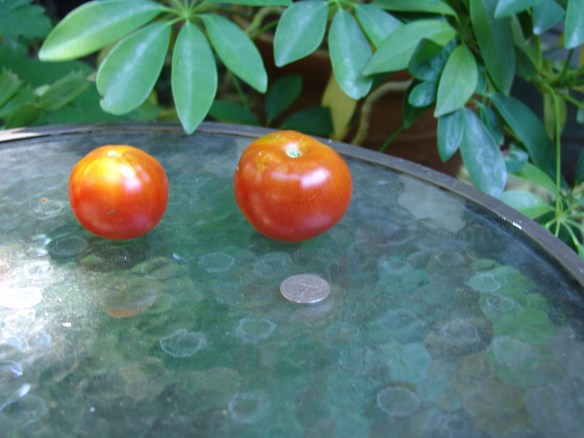
Here are three Krainiy Sever tomatoes, recently picked. They are juicy and fairly dense. I placed them together with a quarter for scale. When I read catalogs and see “this plant produces 1 oz. tomatoes in abundance” I always wonder that that looks like.

Having grown tomatoes for at least 20 years, I can tell you their is a wide variance in the weight of tomatoes. It depends on how dense, how juicy, what the seed cavities look like, etc.

The Krainiy Sever is one of the dwarf series that I sold this year.They are a pretty standard tomato, not especially packed with flesh like a paste tomato or hollow like stuffer tomato.

Fair2011WithTomatoes (9)The biggest tomato I’ve ever grown was a Rose. It weighed over 3 pounds! This variety is very juicy and solid.

krainiy-sever-quarter-2-oz

2 oz Krainiy Sever

krainiy-sever-2.6-oz-12.6 oz Krainiy Sever

polar beautyquarter - 113.6 oz Krainiy Sever

How to Identify and Fix Plant Nutrient Deficiency? – Quiet Corner

A nice resource for detemining what your plant is suffering from, excluding bugs or diseases. Courtesy of the Quiet Corner


Source: How to Identify and Fix Plant Nutrient Deficiency? – Quiet Corner

The Biggest and Most Beautiful Petunias, Fluffy Ruffles, That I Grow (and Sell in the Spring)

CA-Giant-3Also known as Superbissima Grandiflora. In fact that is the only name I had for them for the longest time. After doing some research, I found out they used to be called California Giants and are an heirloom petunia from way back. They are no longer commercially grown, at least I’ve never seen them at the big box stores or local nurseries.
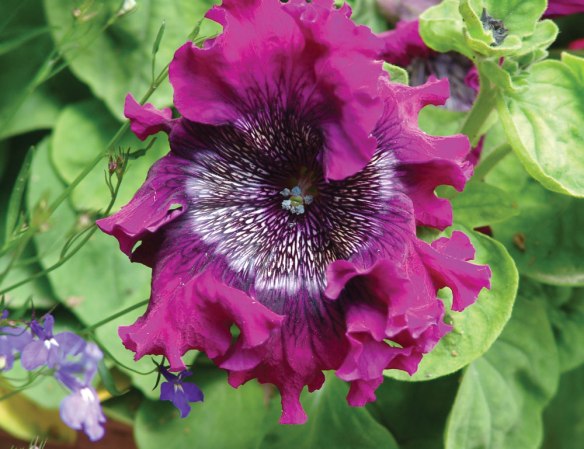
They are huge, sometimes reaching 5″ across! In colors of dark purple and lighter pink, they have fantastic, contrasting veining in their centers.

CA-Giant

Fluffy Ruffles

Fluffy Ruffles has, well, a lot of ruffling! Double Fluffy Ruffles has even more.

CA-Giant-4

Double Fluffy Ruffles

Dark green foliage, rounded leaves and thick stems compete the plant. Usually when a plant is not carried commercially in the petunia world, it’s because it doesn’t live up to the weather or produce reliably. I have not found this with this petunia. It hangs from a basket nicely, is a pleasure to deadhead, lasat for a long time and produces lots of blooms. I use it with other flowers to fill a pot. Because it is so stocky it holds up well to the weather in my garden.

floral-display

This is my favorite petunia! If you would like to come by and see it in my garden and the different ways I use it give me a call. I’ve had people come by and are stunned and perplexed when they see it. They don’t know what it is! You can buy them from me next spring as I will always grow it.

Extra Tomato Seedlings: What Do Geiger Correctional, Local Food Banks, And The Tomato Lady, Have In Common?

Read on for the answer.

I was able to transplant the little green guys in the last couple of days. Not trying to toot my own horn but I gave the “leavings” away to the Geiger Correctional facility. (I had met one of the correctional offices at a banquet honoring our local law enforcement and since I ride with SCOPE Mounted Patrol, was able to participate. He had expressed interest in my plants and I invited him out to see them. Last year he came and bought several flats of them.)

I always plant what I know I can sell and since I tend to over seed, I usually have leftovers. What to do with the leftovers. Bright idea – offer them to Geiger! I emailed and offered and they were very happy about it.

Either I give them to friends or wait until they grow to big for the cell pack, roots coming out the bottom, looking a little peaked and then toss them out. Kind of like leftovers in your fridge, you’d feel bad tossing it out right after dinner, even knowing you won’t ever eat it. No, you have to wait until you discover them at the back of the fridge and they look something like a science experiment gone bad. Only then can you profess surprise and astonishment and feel righteous about throwing them out! You all know what I am talking about.

Thanks to Zac, Dan and Ray for coming out to get the plants. And thanks for allowing me to show you how we transplant and care for them here at The Tomato Lady. The inmates at Geiger have a spectacular garden and start most of their plants from seed, however, these are like instant tomatoes, just transplant, water and pouf, you have a tomato plant. They harvest all the veggies they grow and give them to food banks and other places that hand out food. I believe they delivered over 23,000 pounds of food last year. It serves more than one purpose, hungry people get fed fresh produce and it gives the inmates a sense of accomplishment. Everybody wins!

I was so excited for them to go to a good home. There is going to be a lot of head shaking when they show up with striped, yellow, pink and green tomatoes. Instead of the usual red they know and love. All I can say, is live a little and try something different. You might be surprised at what you’ve been missing by only eating red tomatoes!

Try Something New: Dwarf Fred’s Tye Dye Tomato

fred's-tye-dyeMeet Fred’s Tye Dye. I don’t know who Fred is but I love his tomato. This is another tomato out of the Dwarf Tomato Project. It is the most beautiful color, hopefully you can see the stripes in this picture, it is from my garden. The taste was delicious. The growth habit very manageable as you can see below. This is a mid season producer and is one of the taller dwarfs although mine didn’t get any taller than 4 feet. It was one of the first ones to color up. As with any heirloom, size varies from baseball to softball size. One of the other things I like about the dwarfs is their stocky stems and their rugose, regular leaves, very crinkly and dark green.

fred's-tye-dye2

Over all, I was impressed with the tomatoes I grew out of the Dwarf Tomato Project with the exception of one.